

When the Grenkeleasing Rapid World Championship will begin as part of the Chess Classic Mainz, World Champion Vishy Anand will try for the eighth time in a row to defend his rapid chess title. All in all he won the main event of the Chess Classic no less than ten times. Harry Schaack talked to the World’s number one about the peculiarities of rapid chess and the opponents he will face this year. (Translation by Johannes Fischer)
Mr. Anand, for more than ten years you have been the world’s best rapid chess player, which is also shown by your impressive series of ten wins at the Chess Classic. What are the most important qualities necessary for successful rapid chess?
Anand talking about the Rapid Chess World Championship in Mainz
Generally, there is no difference whether you play short or long games. If you play well, you usually play well in both disciplines. The difference lies in the way you have to focus. In rapid chess you have to give everything in 30 minutes, whereas you can allow yourself a 10 or 20 minute break in a seven hour game. Another difference is that you have to react very quickly when confronted with an opening novelty. This year Aronian came up with a spectacular novelty against Leko at the tournament in Morelia, and Leko thought one and a half hours about his reply – the amount of time you do have in three rapid games. With 30 minutes on the clock you have to be able to react very quickly. Apart from that, it’s simply important to play a good move (laughs). I like rapid chess because I find it easier to focus only for half an hour. And I think this way of playing chess is also very attractive to the public.
What about psychology? I would guess it’s psychologically particularly demanding, because you need to overcome defeats very quickly?
Yes, playing three games per evening means three periods of enormous emotional pressure. You have to learn to cope with the emotional ups and downs and to forget losses quickly. However, in contrast to a long game in rapid chess you do have the chance to straighten things out immediately by winning the next game.
What do you expect from this year’s Grenkeleasing Rapid World Championship?
I look really forward to play rapid chess in Mainz, because my results have not been particularly good this year.
You were out of shape at the Melody Amber...
Yes, this tournament was simply a disaster. I can’t remember ever having had such a bad result. But in the other tournaments, too, something was amiss. In Leon I had to fight a lot against Paco Vallejo and in the final against Ivanchuk I neither played particularly well. I hope things will run more smoothly in Mainz.
You do want to regain some lost ground at the Chess Classic?
Yes, during the last years I have won Leon three times and I have won the Rapid Chess Tournament at the Melody Amber four times in a row. But this year, things have not been going too well. I do have this in mind and I know that I have to work hard to be successful. All my opponents in Mainz are in excellent shape and have achieved a number of outstanding results in the last months. Both Carlsen and Morozevich have had a convincing and impressive year. And Judit Polgar is always dangerous. She takes to rapid chess like a fish to water. This is an excellent field and I think this year it will be harder than ever to defend my title.
How do you feel about the Chess Classic? Is the familiar atmosphere important for you?
There are tournaments, which I have played so often at a certain time of the year that I cannot remember ever to have done anything different at that time. In August I usually have been in Mainz and in January I am always at the tournament in Wijk aan Zee. In 2002 I did not play in Wijk and asked myself: so, what do you do with your spare time in January now? (laughs). Of course, you get used to these regular tournaments. However, each year you have to think about them anew. It would be fatal to believe things will run on their own. But of course I know exactly what I do in Mainz. Everyday I take a walk along the Rhine, I do have my favorite restaurants and I know what I will do before the game. As far as that is concerned, there are hardly any surprises anymore.
Anand with Chess Classic main organiser Hans-Walter Schmitt
Do you feel pressure because of the success you have been enjoying at the Chess Classic for such a long time now?
I try not to think too much about this. Now I can say that I have been winning eight times in a row. But each year the tournament is a new experience in “surviving” (laughs). Every time I manage to better my own record I am happy. Of course, I hope that my series will still continue for a while.
In October you will defend your title of World Champion against Vladimir Kramnik. Since months you have been preparing for this event. Could you focus on the Chess Classic as well as in the years before?
Last year, I could not prepare particularly thoroughly for Mainz either, because of the World Championship in Mexico. But these four player tournaments are easier to play. If you have to play a match as you had once had to at the Chess Classic you have to work much more to prepare. At a tournament you prepare in a much more general way and you do not have to go to that deep in your analysis. However, in rapid chess it is first of all important to play well. You have to have a clear head at the board and you have to be fresh. In rapid chess your performance depends on your play at the board not on your preparation. This is difficult to control. You have to focus to be able to react quickly and alertly – even more so than in classical chess. That is the most important.
This year you will face the new "Bobby Fischer": the Norwegian Magnus Carlsen. He might even be better than the American at 17. Do you see parallels between the two?
That is difficult to say because I know Carlsen personally and regularly play against him. Though I met Bobby Fischer once, I have never played against him – it is just not the same. He stopped playing 1972. However, you can say that both have a simple way to play, both are “classical” players. They do not strive for complications, but choose moves which later are easy to understand. That’s what I mean with “classical”, a kind of style one can also find in the games of Capablanca. Carlsen and Fischer are both brilliant in simple technical positions. This year, Magnus has often won positions, in which he had only a small or even no advantage at all. Usually you need to be older for such a mature style. Carlsen actually does not yet have the experience to play this way. It is a bit surprising to see that he is already that far with 17 years of age. That is very impressive. You could say that both Fischer and Carlsen had or have the ability to let chess look simple.
People eagerly await the battle between you and Magnus Carlsen in Mainz. You have never lost a long game against him.
That’s true, but I don’t want to talk much about that because I hope this will last for a long time (laughs). Carlsen is developing very quickly. The Magnus from August is no longer the one from January.
What do you think about Carlsen’s skill in rapid chess?
Carlsen belongs to the generation of players who often play blitz on the internet. You don’t have to explain to him why rapid or blitz chess is interesting. For him this is quite natural, he grew up with it. This is something the great players of the past could not do. These young players do have a different perspective on these things. Carlsen, too, belongs to this "computer generation". This is particularly apparent if you remember that the computer program "Fritz" is older than Carlsen. Today, everybody is used to playing rapid chess.
Anand in a simultaneous exhibition in Mainz
Currently Alexander Morozevich is number 2 – behind you – on the official FIDE ranking list.Again and again he achieves excellent results, but in top tournaments he occasionally performs not as good as one would expect. Is this due to his style, which does not work against the top players or is this a psychological problem?
I don’t know. I play at least twice a year against him, at the Melody Amber, and there he is really very dangerous. It is not for nothing that he often won the overall competition – blindfold chess and rapid chess together.
How would you characterize his style?
His way of playing is something special, and of course not as classical as Carlsen’s (laughs). He plays very, very creatively and extremely aggressively. He tries to disturb the balance on the board no matter what it takes. This exerts an enormous pressure on his opponents. This style is very difficult to emulate. In his way to play chess Morozevich is unique.
Does he not also play with enormous risks because he wants to win at all costs?
Maybe, but I believe he does not think that he takes a lot of risks. The positions he reaches are very unusual for us but not unusual for him. In hair-rising complications he feels as much as home as Ulf Andersson in an equal endgame. His way to understand chess is clearly different from most other top players. However, it is obvious that someone who again and again managed to climb to the top of the world’s ranking list is simply a top player – no more and no less. Currently he is one of the outstanding players of the world.
In 2003 you played quite an intense match against Judit Polgar at the Chess Classic. All games were decided. Your games against Judit are marked by remarkable aggressiveness: 70% of the games had a winner, which is rather unusual on your level. Even the draws, such as the one in Wijk aan Zee 2003 are fought with utmost sharpness.
Indeed, to play with Judit is really something special. In a rapid chess match in Parla, in which I won 4:2, we did not have one single draw either. Judit is particularly good in tactical positions. Of course, she also has a good positional understanding, but it is in tactical positions that she is able to display her most marked strengths. She has a very good feeling for these tactical positions. One reason for the few draws between us is certainly the choice of openings. We both like the Sicilian, and thus we often reach this kind of tactical positions. And our overall result is really strange. I think, with no other player from the world’s top I have played such a small number of draws.
So all participants are known for their extremely aggressive style..
Yes, I think, this year it’s going to be very interesting. I think, it might well be one of the most exciting events of the Chess Classic.
Friday, August 1, 2008
Anand Interview : "I think, this year it might well be one of the most exciting events of the Chess Classic"
Tuesday, January 1, 2008
Viswanathan Anand was voted DNA sportsperson of 2007

A day after Viswanathan Anand was voted DNA sportsperson of 2007, the world chess champion says he wants to win the honour in 2008 again. Here is a tete-e-tete:
Q:You have been chosen DNA sportsperson ahead of players like MS Dhoni, Yuvraj Singh, Sania Mirza, Jeev Milkha Singh, Narain Karthikeyan...
A:It feels very nice to win a poll where people support you. I would like to thank your readers and wish them all the best in 2008.
Q:What is your chosen moment of Indian sport in 2007?
A:Winning Mexico.
Q:How do you look forward to 2008?
A:It will be a tough year. Some tournaments in the first half and the match with Vladimir Kramnik in the second half.
Q:It will be yet another World championship year. Your thoughts?
A:Yes. I will first concentrate on my events till March and then start work on Kramnik.
Q:Finally, any thing you think you need to conquer?
A:To win DNA sportsperson of the year in 2008 by winning in October would be nice.
Wednesday, November 21, 2007
Vladimir Kramnik: “Winning the match against Anand
Interview with Yuriy Vasiliev
Chess Observer, "Sport-Express Daily" (Moscow)
This interview with the winner of the Tal Memorial, Vladimir Kramnik, took place immediately after his game with Vassily Ivanchuk of Ukraine. This game turned out to be the longest in this final round of draws…
Vladimir, the tournament in Moscow was dedicated to the memory of the eighth world champion, Mikhail Tal. What do you think of him? Did you ever meet him across the board?
We played two rapid games. It was in 1991, the year before he died. Of course, at that time, Mikhail Nekhemyevich was not the man he had once been, but such was his unique charm that I fell under his spell even in such a short acquaintance. Tal was an exceptionally well-rounded chessplayer. The usual picture of him, as constantly playing adventurously, always sacrificing pieces, does not do justice to the real genius of the man. A few years ago, I looked through a collection of his best games, and realised that he played a great many games in really excellent positional style. In his youth, yes, he used to create these combinational tornados on the board, but in his later years, he simply outplayed his opponents by virtue of his deeper understanding. It is wonderful that the Russian Chess Federation is running a tournament in his honour. Tal is probably the most colourful of all the world champions.
You managed to score plus-four in this tournament in his honour, a tournament of category 20. Surely now nobody can say that you are “only a match player”…
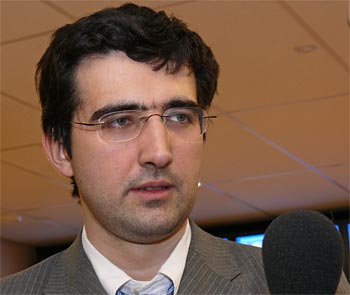
This year I have won several tournaments. Only in Mexico did things not go right – although, even there I did not play any worse. I simply did not have enough luck. Here, fate was on my side.
In two of your games, against Leko and Shirov, everyone was astonished at the fantastic technique you showed, in converting a microscopic advantage. Some people are saying that your technique is better even than that of the legendary Capablanca
I would not compare myself with Capablanca, that’s going too far... But nobody can argue with the fact that I perhaps have the best technique of any player around today [smiles].
But your game against Mamedyarov in the penultimate round, you played in quite a different style – very sharply and riskily. This game reminded me of the days of the tournaments in Novgorod [in the mid-1990s]. Don’t you think so?
A lot depends on who you are playing. Mamedyarov is a very principled player – he plays sharply, comes at you, and tries to win. I have never avoided sharp play, but it does not usually arise, because my opponents play with a greater measure of safety. Therefore, in the game with Mamedyarov, and also that with Alekseev, I showed that I can also play a different style of chess from that in the games with Leko and Shirov.
Maybe the time will come when you can relegate to the past your well-known match strategy: win with white and draw with black?
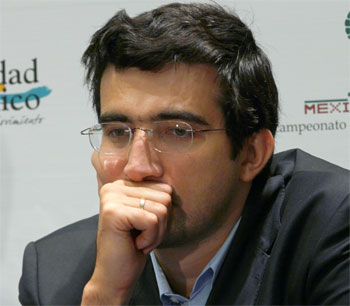
Some problems remain. For greater success in tournaments, my repertoire is still a little too dry with the black pieces. In this tournament, it did not matter, because I won nearly all my white games, but in some other tournaments, it prevents me achieving better results. But, as you may have noticed in Mexico, I am trying to play in a more universal style.
In this tournament in Moscow, you were assisted by Dutch GM, Loek van Wely, although in Russia in general, and Moscow in particular, I know that you have many friends amongst the grandmaster ranks. What made you decide to work with the Dutch grandmaster?
As far as my friends and colleagues in Russia are concerned, they are all busy at the moment, but notwithstanding this fact, I would have taken van Wely with me anyway. I like him as a person, he is a very cheerful young man. And he also suits me as a specialist, as he has many interesting ideas. We started working together prior to Mexico, and I will be pleased to work with him in the future.
Van Wely will be one of the players in the January tournament in Wijk aan Zee, and will therefore not be able to help you then. What are your hopes for this tournament?
Yes, Loek will play in the main tournament, so I will have another second. In the past, for some reason unknown to me, I have not played so well in Holland. But this time, I am very determined. It will be a very important tournament, with an extremely strong field. I very much want to win the tournament, both to strengthen my number one position in the world ratings, and also to prove something to myself. I have more than one month to prepare, which is good, and I will prepare very seriously for Wijk-aan-Zee.
One of the biggest statistical specialists in the chess world, Edward Dubov, who calculates the current ratings of all the top players, told me that after your success in Mexico, you will go top of the January rating list. Does this mean a lot to you?
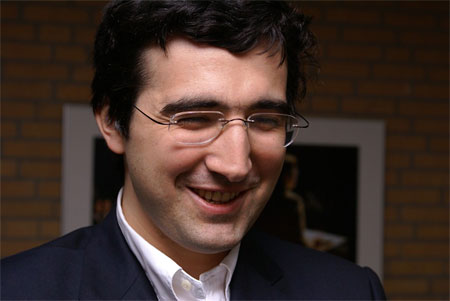
Several people have already told me this. Of course, it is nice to go to number one in the rating list. Not so many people have ever done this. But I cannot say that I attach huge importance to it. Firstly, because I have already been number one once before. It was quite some time ago – in 1996. Now I have become number one again. I don’t know how long I will maintain this position, but I will try to hang onto it for as long as possible. But for me, winning the forthcoming world championship match against Anand is much more important.
Is everything going OK as regards the match?
I can say that there are no problems on my side. I have signed the contract and sent it off. I know that Anand is having discussions with FIDE, but I do not know the details. On this subject, you should ask the FIDE leadership and Anand himself.
What do you think about the match with Anand?
He is a very serious opponent. Chances are about equal. Everything will depend on the details. Who prepares better. Who puts together the best team. Lots of little things, which in reality are not little things at all. I never try to guess the future, I just do everything that I can do. And if this proves enough for victory, I will be very pleased.
The match will take place in the autumn of next year. Where do you plan to play before then?
After Wijk aan Zee, I will play in Monaco, and in the summer in Dortmund. I hope to play somewhere else as well, before the match.
Will you play in Linares?
No, I am skipping Linares. That would be a bit too much work.
On the day this interview appears in “Sport-Express”, the world blitz championship will take place in the exhibition hall of GUM [a major shopping arcade in Central Moscow, opposite the Kremlin]. You have by no means a bad previous record in this form of chess. One only has to recall your drawn blitz marathon against Kasparov, played in the Cosmos Hotel, or when you won one of the strongest Moscow blitz tournaments with an almost 100% score. What are your hopes this time round?
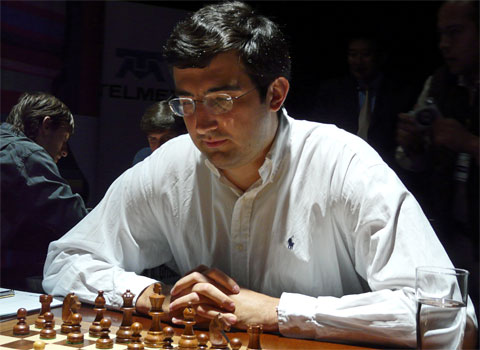
The results you mention were a long time ago (smiles). Nowadays I only play blitz very rarely, and look on it as just a relaxation, which of course is what it is. In blitz, it is very important to be what they call “a practiced hand”. I will try of course, and will do a little bit of training beforehand, and try to remember my past triumphs. But playing the younger generation will not be easy. I know that they spend days and nights on various websites, playing blitz. This is interesting, but I do not think it is very useful. I do not do it myself. But anyway, I hope I don’t do too badly. I am not setting myself any particular targets. I will just try to enjoy myself.
And what do you think about the so-called “advanced chess” match with Anand, where you can use the computer’s help?
This is purely a show. In this form of play, the computer’s role is 80% and yours only 20%. But this 20% is decisive. You have to know how to use the computer well, when to turn it on and when to switch it off. I hope I manage to do so.
Will your wife Marie-Laure be supporting you during the tournament?
She supports me very strongly, Every round, she phoned me before and after the game, and she reacts very emotionally to my victories. Each time, she treats it like something unusual, historical (smiles). I am always surprised by this, and each time, I try to explain to her that it is normal, and that sometimes I do actually win (smiles). But she is always delighted, like a child. It is nice for me to be able to give this pleasure to her, and to my parents and brother. And to all of my supporters. In Moscow, I felt very strongly that almost everyone was behind me, and this helped to give me additional energy.
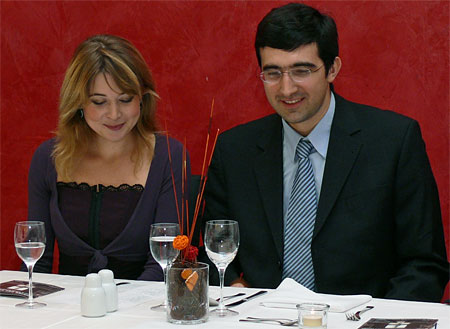
Marie-Laure and Vladimir Kramnik
Monday, November 12, 2007
Chess Interview: Judit Polgar: 'my goal is to raise my children so that they can be happy, successful '

She is far and away the strongest female chess player that ever lived.
[Note: She has always declined to play in competitions limited to females, which is why she never won the Women's World Championship.]
At times she was in the top ten of the overall world rankings, but in the last three years, due to the birth of two children, has dropped back a little in her preparation and results. But as everyone can see from her recent tournaments this remarkable lady is on the rebound.
Interviewing Judith Polgar [born July 23, 1976, in Budapest, Hungary] implies some kind of caution due to her merits she has achieved. Now she has two children aged three and one, and motherhood is the most important thing for her. She is known for having broken many clichés in a world traditionally ruled by men. She was the first person who achieved the title of Grandmaster at the age of fifteen.
[Note: Bobby Fischer was the first, in 1958, when he became history’s youngest grandmaster at the age of 15 years, 6 months, and 1 day. He held the record until 1991, when Polgar broke it. When Fischer became world champion in 1972, before chess ratings “inflation,” there were 88 grandmasters. As of July, 2005, there were more than 900. Link: http://en.wikipedia.org/wiki/Chess_prodigy#List_of_youngest_grandmasters]
Polgar starts playing today in the Champion's League held in Vitoria with the difficult aim of turning the tables with Veselin Topalov as the big favourite.
El Correo: What has led you to compete in the Champion's League Tournament?
Judit Polgar: I received an invitation some months ago and I thought it was very interesting. So far I had never taken part in a tournament which combines both charity and the professional side.
Correo: What are your expectations?
Polgar: I want to play well, and to achieve one of the highest scores.
Correo: What is your situation professionally?
Polgar: Currently I’m ranked number 20 in the world.
[Note: Current Rating: 2708. Highest Rating: 2735. Highest Ranking: No. 8. She is the only woman on FIDE’s Top 100 Players list.]
In the last three years my children, Hanna and Oliver, were born. I had to stop working during my pregnancy, when I gave birth and also after that. All this has led my game through a bad patch, which I’m trying to recover from. It's important to take part in this kind of tournaments so that I can work myself into the top ten again.
Correo: At the end of the 90s you stated that you would rather be happy than a star in the chess world. Do you still think the same?
Polgar: Yes, but I'm aware of the fact that playing chess is part of my happiness too. In the last years I got married and I’ve become a mother. Now I've got a stable life and I'm very happy with it.
Correo: It must not be easy to combine motherhood with such a high level of competition.
Polgar: I'm happy with both and, even if it's difficult to organise personal and professional life, I try to do my best.
Correo: Your father, Lazlo Polgar, an expert teacher, educated his daughters out of the school. He had a particular way of thinking: “Geniuses are made, not born”. Can intelligence be taught?
Polgar: Yes, I believe in what my father said. It's always important to focus on an area of education. In fact, I think it should be a compulsory subject. In Brooklyn they carried out an experiment which consisted in initiating problematic children in chess. As they improved in chess, their marks did too. This is only an example of how much can chess help.
Correo: Can playing chess help solve the everyday problems as Gary Kasparov claims in a book?
Polgar: Yes, I think that playing chess can be a good way of training your mind to face everyday life. Playing chess has many aspects that can be useful in everyday situations like planning, concentration and combinations. You learn to win but also to lose and to be creative.
Correo: Can there be a female chess revolution in this century?
Polgar: Right now the part played by women is changing everywhere. Personally, I wouldn’t look at chess from the female point of view but rather observe the evolution that it has had in every country. India and China are improving by leaps and bounds and it will be their chess players who will lead the revolution of the XXI century.
Correo: What feeling do you get when you are described as the best [female] chess player of all time?
Polgar: I’ve been playing since I was five and I have got used to the big names. It’s something I no longer consider important. It will be something to tell my grandchildren but nothing more.
Correo: Has Judit Polgar ever had any idols?
Polgar: I have never had idols in chess. As time went by I followed some players more than others, some moves, some moments...
Correo: How would you define your game style?
Polgar: I am known to be a very aggressive player, an attacker. It’s more difficult to be one when playing black, but I try to develop that aspect with them too.
Correo: Do you identify yourself with any particular chess piece?
Polgar: The knight is my favourite.
Correo: Are glances in chess really as important as they say?
Polgar: To me, chess is a psychological game and glances are a part of this personal game. But I don’t think they have the importance everybody keeps trying to give them.
Correo: What do you think about the controversy generated during the last years about whether chess is or not a sport?
Polgar: This is a question that has appeared in many countries. One can say that in the last decades chess has become more of a sport than of a science. I see it from an artistic point of view.
Correo: What kind of hobbies does a grandmaster have?
Polgar: I like nature, animals and going to the theatre a lot. But of course now that I have two children I don’t have free time and try to combine my hobbies and my family.
Correo: You have fulfilled many of your goals from getting into the world’s top ten to defeating players like Kasparov. What are your aims now?
Polgar: From a personal point of view, my goal is to raise my children so that they can be happy, successful and take care of themselves in the future. To support them all the way. Whatever they do, their mother will always be there for them. From a professional point of view, now that I have a family I choose the tournaments I play in, why and against who a lot more. I want to play chess while I’m still fascinated by it. The moment I stop having fun, I will quit this.
Translation by Aitziber Elejalde
Click here if
you like this article
Brain power -Susan Polgar
 |
Susan Polgar is profiled in Make Me a Genius on National Geographic Channel. |
It examines three groups of genius who answer questions about human intelligence.
Do difference in gender, brain size and brain hemisphere dominance enable these remarkable individuals to excel so far beyond their peers? Or, can education and environment help fuel intelligence and enable anyone to become a prodigy, if given the opportunity?
It features extraordinary characters; scientists embarking on fantastic journeys into the hidden depths of the brain, and people with amazing abilities, whose brains we can learn from.
Woven through these elements, surfacing occasionally when it serves the narrative, are stories of ordinary families on an emotional journey that relates to the brain.
Using computer-generated images, brain scans and expert testimony, My Brilliant Brain unlocks some of the brain's biggest mysteries.
The first part, My Brilliant Brain: Born Genius (Nov 26, 9pm) introduces viewers to Marc Yu, an amazing seven-year-old classical concert pianist whose brain is specifically created for music.
At two years old, Yu taught himself how to play Mary Had a Little Lamb on the piano. One year later, he was tackling Beethoven. Yu also has perfect pitch – the ability to identify musical notes as easily as identifying colours – a skill that only one in 10,000 people can claim.
My Brilliant Brain: Make Me a Genius (Dec 3, 9pm) profiles Susan Polgar whose unique education early in childhood shapes a supreme ability to play chess, making her the world's first female chess grand master.
Delving deeper into the minds of savants, My Brilliant Brain: Accidental Genius (Dec 10, 9pm) shares the story of one man who suffered a serious brain injury that released a manic talent for painting that he had never known.
Courtesy -http://www.star-ecentral.com/news/story.asp?file=/2007/11/12/tvnradio/19398518&sec=tvnradio
Chess Books Click Here!
Tuesday, November 6, 2007
Anand blasts FIDE's 'political patronage' of Kramnik

06.11.2007 – Gentlemen, let the hostilities begin. After Vladimir Kramnik passed some disparaging remarks about Vishy Anand's world championship win ("I have lent Anand the crown") in an Izvestia interview, the Indian star strikes back in a national newspaper, saying Kramnik's arguments were based on mere technicalities. Anand also reveals that he may soon move back to India. Hindustan Times stories.
Kramnik says he has lent Anand the crown; champ laughs it off
Long after the bitter days of rivalry between Kasparov and Karpov, another chess star war seems to be in the offing. Vladimir Kramnik, dethroned as the FIDE world chess champion by Viswanathan Anand, has passed disparaging comments against the Indian star, who has retaliated strongly.
In a recent interview to the Russian newspaper Izvestia, Kramnik said that he has "lent the title temporarily to Anand". He added that he would accept Anand as the champion only if Anand wins their rematch next year. "OK, on paper Anand may be world champion, but from my point of view, there is a difference in significance between a title won in a match and in a tournament," Kramnik said. "For me, the forthcoming match with Anand is more important. If I lose that, I will accept completely the fact that I have lost the title."
Kramnik's comments re-ignite the debate over the best format for the event, apart from showing Kramnik in a poor light, for he had acknowledged Anand as the champion soon after the World Championship in Mexico in late September. Anand has suggested that Kramnik's argument was based on mere technicalities. He reacted strongly to Kramnik's comment and told HT: "He is trying to make the most of the political patronage he enjoys from the FIDE. Kramnik's position seems like a legal explanation of a situation arising from the political patronage."
"Who the best player in the world is decided on the board," Anand said over the phone from Chennai. Kramnik also claimed that his rematch with Anand – a gift guaranteed to the Russian by the FIDE even before the Mexico event – would be played in September 2008 in Germany. Kramnik told Izvestia that sponsors and organisers were already in place and contracts would be signed within a month. Anand refuted these claims and said nothing had been decided as yet.
Sunday, November 4, 2007
Vladmir Kramnik: "I have lent Anand the crown"

The former world champion Vladimir Kramnik is currently in Moscow, preparing for a series of tournaments in November and December, namely the Tal Memorial, then the World Blitz Championship, and finally, a two-game mini-match of “advanced chess” against Anand himself. Before leaving for Russia, he gave an exclusive interview to the French correspondent of the Russian newspaper Izvestia, Yuri Kovalenko. This contained a number of interesting comments.
Asked about his reaction to losing his title after seven years, Kramnik commented: “OK, on paper Anand may be world champion. But from my point of view, there is a difference in significance between a title won in a match, and in a tournament. For me, the forthcoming match with Anand is more important. If I lose that, I will accept completely the fact that I have lost the title, but right now, I have no such feelings. At present, I take the view that I have just lent Anand the title temporarily”.
The World Clay Champion?
When it was put to him that Anand was surely the strongest player in Mexico, Kramnik replied that the situation is like tennis: “Federer is better than Nadal, but cannot compete with him on clay. Everyone has their strong side. Mine is match-play, whereas Anand’s is tournaments. He is very even and stable, and can draw with the top players and beat those lower down.”
Kramnik also rejected claims that he was just trying to comfort himself, saying that his attitude to wins and defeats was nowadays a rather Buddist-like indifference. “I accept responsibility only for the quality of my work, not its result”.
Asked when and where his return match against Anand will take place, he replied that it was most likely to be in Germany in September 2008, adding that sponsors and organisers are already in place, and contracts will be signed within a month. Interestingly, in answer to the question of who his next opponent would be, if he were to beat Anand and regain the title, he replied “FIDE has decided that the winner of Anand-Kramnik will play against the winner of Topalov and the World Cup victor”. Old-style Cold War Kremlin-watchers may have sought to read some significance into his exact choice of words – not “I will play…” but “FIDE have decided that …”! Could there be a “but” lurking in there somewhere? Watch this space…
"I cannot see myself playing beyond 40”.
In reply to a question about Korchnoi’s longevity in chess, Kramnik replied that he has not the same fanaticism for the game as Korchnoi, and that once he feels he can no longer compete at his former level, he is likely to drift away from chess. “I cannot see myself playing beyond the age of 40”, he said.
For the present, though, Kramnik is fully devoted to chess in a thoroughly professional way. “Chess is like body-building. If you train every day, you stay in top shape. It is the same with your brain – chess is a matter of daily training”. He admits that by character, he is something of an Epicurean, but insists that he observes a fairly careful discipline, having stopped smoking - “at least, for the time being” – and not having consumed enough alcohol to get himself drunk for a long time. Gambling is not one of his vices, he says, adding that he finds poker “…rather one-dimensional and colourless compared with chess”.
“I want my children to speak Russian and have a Russian mentality”
His French wife, Marie-Laure, has retained her own surname, rather than becoming Mrs Kramnik, but Vladimir said this was largely for professional reasons (she is well-known in journalistic circles). “When we have children, they will have my surname”, he said. He also added that he wants his children to be Russian, rather than French. “I do not yet know where we will live, in Russia, in France, or somewhere else. But I definitely want my children to speak Russian and have the Russian mentality”. He also reveals that Marie-Laure speaks excellent Russian: “Russian tourists in Paris often end up speaking with her in Russian, and are always sure she is Russian herself, although she actually has no Russian roots at all”.
“I do not have time for politics at the moment”
Finally, Kramnik revealed that he has been approached several times by Russian political parties, hoping to enlist his public support, but that he has resisted: “I do not want to get involved in party political games”. In another phrase that might interest the Kremlin-watchers, he adds “ I do not have time for politics at the moment ”. Hmmm – “at the moment”. Could it be that Kramnik’s absence from Russian politics is just a temporary thing – like his loaning of the world title to Anand….?
Courtesy- chessbase